AI advertising | Multi-quarter research watchlist
AppLovin has built a highly profitable advertising platform around mobile gaming. The next investment test is whether it can sustain its competitive advantage while turning e-commerce into a larger, durable source of growth.
Core Thesis
AppLovin offers exposure to AI that already supports a substantial commercial business. Its investment appeal rests on whether better advertising predictions can keep producing better customer returns—and persuade those customers to spend more.
The opportunity is to extend that engine beyond gaming. The risk is that improvements become harder to produce, competitors catch up, or new advertisers fail to scale their spending profitably.
My view is constructive but conditional. This is a business to evaluate quarter after quarter, with particular attention to advertiser economics, cash generation, and the contribution from e-commerce. A larger potential market strengthens the opportunity; execution determines how much of it shareholders ultimately receive.
Business Segments
AppLovin reports one operating segment. The following describes its main products and customer markets, rather than separate reporting segments. [2]
Finding customers: AppLovin Ads and AXON. Advertisers use the platform to reach potential customers. AXON, its AI recommendation system, estimates the likelihood and value of outcomes such as engagement, purchases, and repeat spending. The aim extends beyond generating an installation: it is to acquire customers at a cost that supports an advertiser’s return goals. [3]
Monetizing apps: MAX. Publishers use MAX to run auctions for advertising space inside their apps. Multiple advertising networks compete for that inventory, helping publishers monetize their audiences. [4]
Expanding beyond gaming. Retailers can advertise products to people playing mobile games; e-commerce expansion does not require AppLovin to own an online marketplace. Public self-service access launched on June 22, 2026. The customer-facing platform is now called AppLovin Ads, while AXON remains the recommendation system’s name. [5]
Performance marketing describes the return advertisers seek. It does not mean every arrangement is billed only after a purchase. AppLovin recognizes both impression-based and action-based revenue, net of publisher inventory costs. [2]
Competitive Position
The potential advantage is the combination of distribution, prediction, and feedback from advertising outcomes. AppLovin’s management describes an integrated system connecting supply, advertiser demand, and optimization. [3]
The investment inference is that better predictions can support more competitive bids while preserving advertiser returns. Sustained results could attract additional budgets and strengthen the platform’s economics. That advantage must keep earning its place through performance.
Data access needs careful wording. Owning MAX does not establish unrestricted rights to use every participating network’s information. AppLovin specifically says its Ad Review product does not feed other networks’ user-level ad output into AXON. The defensible thesis concerns its technology, distribution, and permitted advertising signals. [10]
Financial Profile
AppLovin’s second-quarter results demonstrate substantial profitability, alongside a gap between accounting earnings and quarterly cash flow. [1]
The 84% figure is a non-GAAP margin that excludes expenses including stock-based compensation, taxes, interest, and depreciation and amortization. It is calculated on reported revenue, which already excludes publisher inventory costs. It should not be described as keeping 84 cents of every advertiser dollar as profit. [1, 2]
Free cash flow grew approximately 12% from the prior-year quarter, slower than revenue. That is a reason to follow cash conversion across several quarters, including working-capital and tax timing, before treating adjusted EBITDA as a proxy for cash available to shareholders. The growth rate and cash-flow margin above are calculated from the reported figures. [1]
Management attributed the slower sequential growth to smaller AI model improvements during Q2 and said a larger improvement arrived after quarter-end. That explanation remains a claim to test against subsequent results. [6]
| Metric | Q2 2026 |
|---|---|
| Revenue | $1.924 billion |
| Revenue growth | 53% year over year |
| GAAP net income | $1.267 billion |
| GAAP net margin | Approximately 66% |
| Adjusted EBITDA | $1.614 billion |
| Adjusted EBITDA margin | Approximately 84% |
| Free cash flow | $863 million |
| Free cash flow / revenue | Approximately 45% |
Bull Case
The upside case is that AppLovin keeps improving advertiser returns while building a broader customer base.
E-commerce adds another source of demand for an existing advertising audience. Management reported that consumer advertiser spending in Q2 was 28% above Q4 2025. [6] Triple Whale also documents an integration that supplies enriched merchant conversion data to AppLovin. [7]
There is encouraging external evidence. Triple Whale’s research examined 755 AppLovin-spending shops and reported favorable results using attribution, modeling, and a small set of geographic experiments. These findings support further testing, but a cohort of existing spenders cannot establish the success rate for all prospective advertisers. Triple Whale’s integration relationship also matters when weighing its conclusions. [9]
For shareholders, the attractive outcome would be sustained growth in profitable advertiser spending, durable cash generation, and improving visibility into the consumer opportunity. A higher valuation could follow stronger evidence, although it should remain an outcome of the thesis rather than its foundation.
Management is pursuing more complex models and additional compute. Those efforts offer potential upside, but this thesis does not assume a named “AXON 3” launch or a scheduled technological breakthrough. [6]
Bear Case
Monetization improvements become harder to sustain. AppLovin disclosed that Q2 net revenue per installation increased 58% while installation volume declined 2%, both year over year. These are company operating measures, not proof that total gaming-market installations declined by the same amount. [2]
That mix makes continued improvement in revenue per installation especially relevant. It does not establish a fixed growth ceiling: advertiser mix, customer value, and conversion performance can change. It does mean extrapolating recent growth without examining its drivers would be risky.
Competition improves. Unity management reported 23% sequential growth in Vector and an annualized revenue run rate above $1 billion. That confirms competitive momentum; it does not, by itself, prove Unity took a corresponding amount of share from AppLovin. [8]
New advertisers do not become lasting customers. Easy onboarding and pixel installations can generate activity without meaningful revenue. The concern is that retailers test the platform but do not retain or expand budgets after measuring incremental sales.
Compute absorbs more of the economic gains. Management described roughly ten cents of incremental compute spending per incremental revenue dollar. That is an operating framework, not a fixed cost guarantee. [6] The key question is whether additional spending produces attractive incremental cash returns.
Valuation
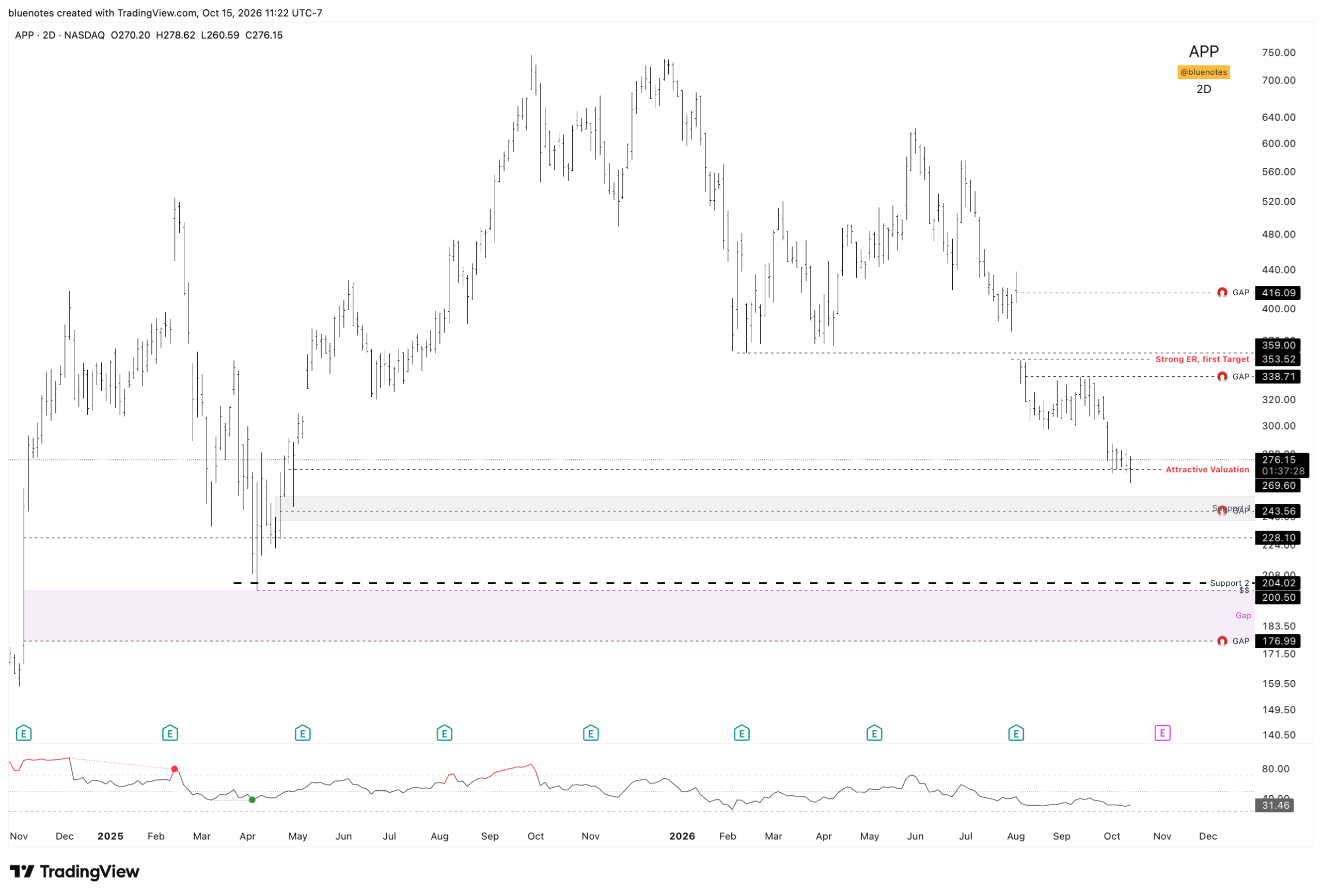
A large share-price decline creates an opportunity to reassess a business; it does not establish that the shares are cheap. October reporting showed AppLovin reaching fresh 52-week lows, making an earlier price reference unsuitable as a standing valuation anchor. [12]
The proposed 12.1–13.1 times forward EBITDA range needs a dated share price, a specified forecast year, an identifiable estimate source, and a consistent enterprise-value calculation before it can support an investment conclusion.
The comparison with Unity also needs care because the companies have different business mixes and profitability profiles. A peer’s higher multiple does not establish the multiple AppLovin deserves.
For this journal, valuation should be updated alongside earnings estimates. Test scenarios in which growth slows and the multiple stays flat or contracts, as well as scenarios in which e-commerce scales. The strongest upside case should have a meaningful contribution from growing cash flow per share, with any multiple expansion treated separately.
What Investors Should Track
The following is my monitoring framework. Several customer-level measures may require management commentary or consistently sampled third-party research rather than a standardized quarterly disclosure.
For the next earnings review, management’s Q3 outlook provides a concrete benchmark: revenue of $2.055–$2.085 billion, adjusted EBITDA of $1.710–$1.740 billion, and an adjusted EBITDA margin of approximately 83%. These are forecasts, not reported results. [6]
Actionable Investor View
I would treat AppLovin as a conditional growth thesis requiring repeated evidence. The next several reports should help distinguish a temporary slowdown in model improvement from a more persistent change in the business’s growth economics.
Pixel adoption belongs on the watchlist, but sustained advertiser spending and independently measured incremental sales carry more weight. A pixel installation alone establishes neither a paying customer nor a profitable advertising relationship.
Legal and platform risks also belong in the operating assessment. Securities claims remain allegations. Separately, AppLovin alleges Unity improperly collected advertising data; Unity disputes those allegations. Outcomes could affect data access, competitive advantage, or costs, giving these disputes potential business consequences beyond short-term sentiment. [2, 11]
Investment Conclusion
AppLovin’s established business gives the thesis substance. E-commerce gives it additional potential. The unresolved question is how reliably the company can turn that potential into durable growth in cash flow per share.
This is an AI advertising expansion story that must be tracked quarter after quarter. That execution risk is also where the potential reward lies.
Sources
- AppLovin: Q2 2026 financial results, August 5, 2026.
- AppLovin: Q2 2026 Form 10-Q, including revenue recognition, operating drivers, segment reporting, and risks.
- AppLovin: The AppLovin business model, February 2, 2026. Management’s explanation of the platform.
- AppLovin: MAX in-app bidding.
- AppLovin Ads is now open to all advertisers, June 22, 2026.
- AppLovin: Q2 2026 earnings-call transcript, August 5, 2026.
- Triple Whale: Sonar Optimize integration with AppLovin, July 29, 2026.
- Unity: Q2 2026 earnings-call transcript, reproduced by Stock Analysis/Quartr, August 6, 2026.
- Triple Whale: Does AppLovin Actually Drive Revenue?.
- AppLovin: Ad quality tools and user-level data, September 16, 2026.
- Digiday: AppLovin and Unity’s dispute, October 6, 2026.
- Benzinga: AppLovin stock reaches a 52-week low, October 15, 2026.