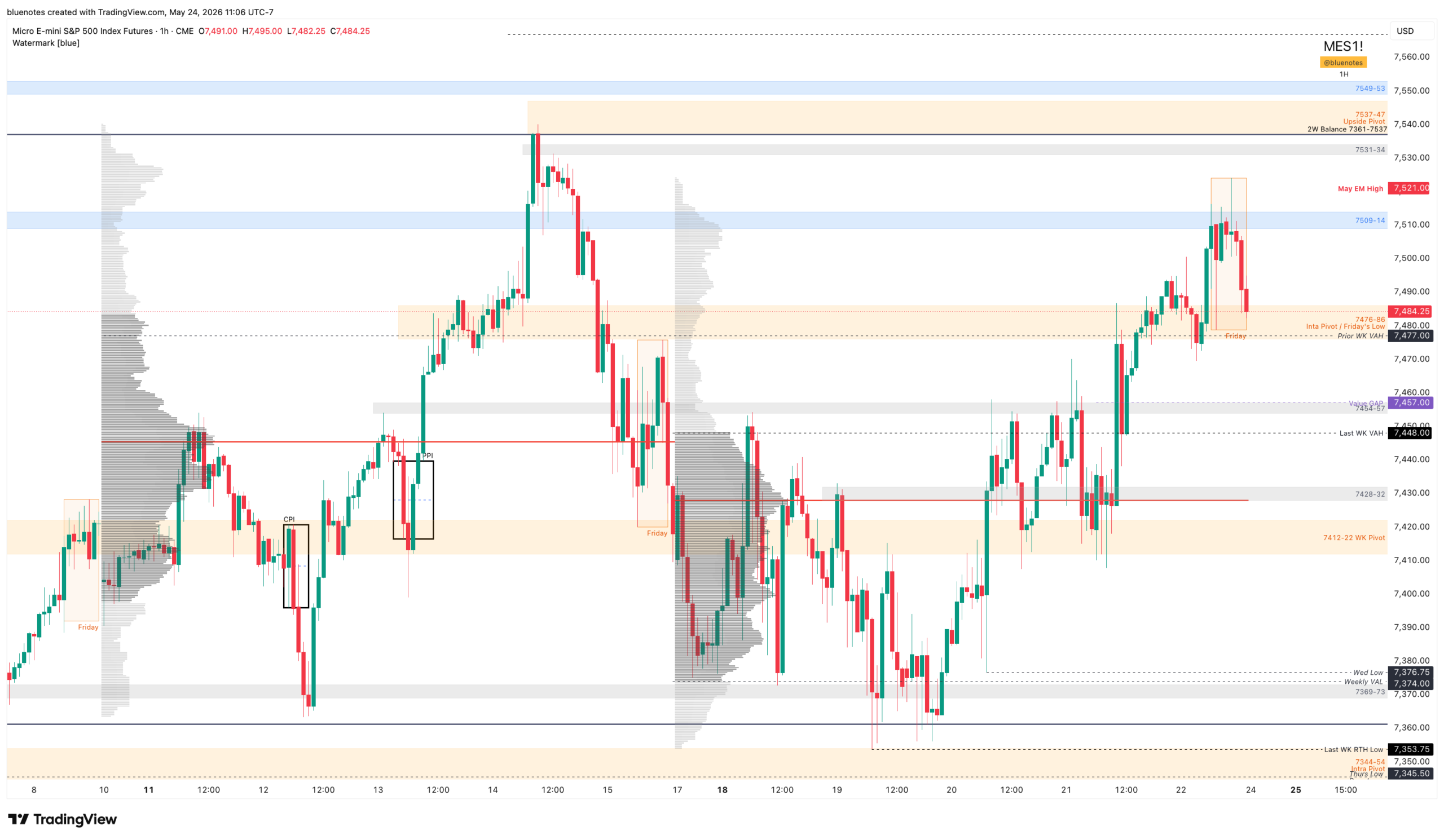
2-Week Balance: 7361-7537
Weekly Pivot: 7479-7489
ES Expected Move: 114pts
Gamma Flip: SPX 7311 / ES 7331 (as of Friday)
Futures open normally on Sunday and will close early Monday morning. Stocks are closed until Tuesday.
Markets head into the week with one dominant feature: a clean two-week balance. That is the big picture, and for now it is the only thing that really matters. Rather than forcing a directional opinion near the top of the range, the better approach is to respect the structure for what it is. We are near range highs, yes, but that alone does not mean an upside breakout is imminent. Friday failed at the top of the range, which keeps open the possibility of an immediate pullback, continued rotation inside the balance, or even a look-above-and-fail before the market makes a more decisive move. Until the range actually breaks, this remains a two-way trading environment rather than a clean trend environment.
That is the framework for the week. A clean break higher offers straightforward upside clarity. A move lower from here does not automatically turn the market bearish; it simply keeps the balance intact and raises the possibility of a deeper rotation within it. Just as it is a mistake to get too bullish at range highs, it would be a mistake to get too bearish into the low of the range if price gets there. This balance can break either way, and it can also simply continue to extend through the week. The goal is not to predict which outcome comes first. The goal is to know the important pivots and react accordingly.
For ES, the upside trigger is clear. A clean break above 7540 would signal an upside resolution from the two-week balance and point toward 7631-7634 as the primary upside target. That is the clearest bullish outcome available. At the same time, the market still needs to be respected for the possibility of a look above and fail (LAAF) in this area. That could come either through a failed break of 7540 or even a failed push into this past week’s 7524 high that falls short of the full range high. Given how many failed upside breaks we have seen, that possibility needs to stay firmly on the radar. Just as importantly, though, any failed breakout means little if the low of the breakout day is not at least taken out. Bulls still control the 30-minute trend, and sellers must first neutralize that before any failed move can develop into something more meaningful.
On the downside, the first key zone is 7476-7486. That area includes Friday’s low, the prior week’s value area high, and the prior RTH bear gap. Without traction below Friday’s low, inclusive of a possible look below and fail (LBAF), ES can simply continue consolidating inside Friday’s range before making a larger decision. If Friday’s low is taken out with continuation, then 7454-7457 becomes the most important support zone beneath. This is a major area across multiple profiles and also represents the 0.382 retracement from this past week’s low to high, making it the healthiest dip to buy within the current range. If price gets there before any confirmed failure at range highs, that is the first spot where the plan should lean toward looking for longs rather than becoming aggressive on the short side.
If 7454-7457 fails to hold, even inclusive of a failed breakdown, then the probability of a deeper rotation toward the bottom half of the range increases. That still does not automatically make shorts comfortable on the first pass lower, especially given how tricky recent weakness has been. But persistent weakness below 7454-7457 would make 7428-7432 more of a waypoint than a destination and would make a move to 7412-7422 (Weekly Pivot) increasingly likely. That 7398-7403 just below the WK Pivot area could still produce a stop run or liquidity grab and reverse back higher, but if price begins building time and volume below it, then 7369-7373 becomes the next meaningful downside reference (Wed low and weekly VAL).
Beyond that, the market would be approaching the lower edge of the two-week range, where the focus shifts from “rotation within balance” to “downside break versus failed breakdown.” That is where the decision tree becomes more complex. A larger move lower from range highs, especially in a shortened week, could leave sellers vulnerable to exhaustion into a fresh LBAF of the broader range. So even if price starts leaning lower, it is important not to assume continuation without confirmation. If the market gets there, the question will not simply be whether price broke the bottom of the range, but whether sellers still have enough energy to sustain that break.
At this stage, the cleanest way to frame ES is that the market has earned patience, not prediction. Near range highs, it is tempting to assume the breakout is next. Near range lows, it will be tempting to assume the market is rolling over. Both can be costly mistakes inside a healthy balance. Respect the range for what it is. Respect 7540 as the upside trigger. Respect 7454-7457 as the first major buy-the-dip zone if weakness develops. And if the market starts expanding out of this 2 week structure, let the break prove itself before committing too heavily to either side.