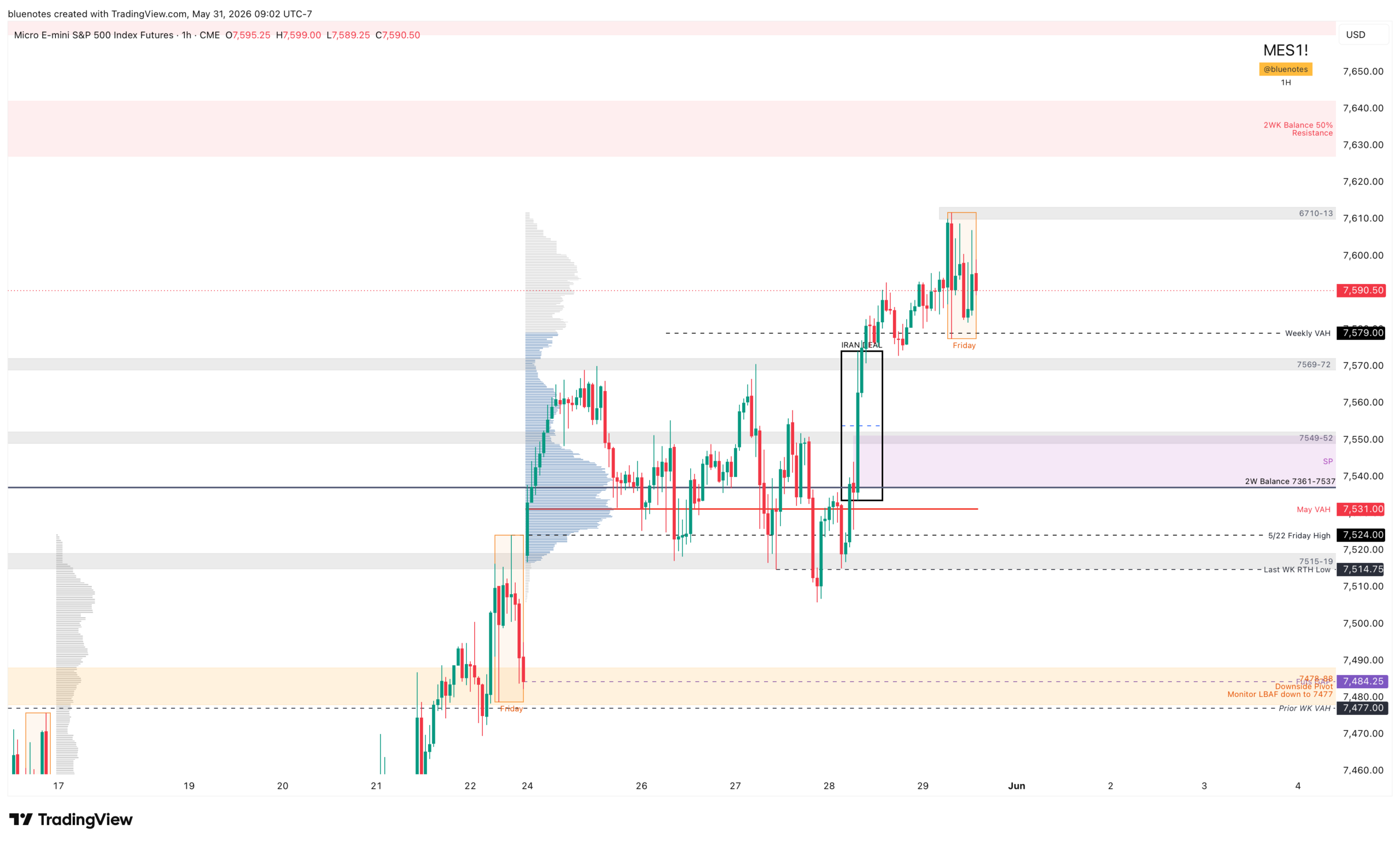
Markets continue to operate in a clearly bullish regime, and that remains the starting point for this week. May value gapped higher, last week also value gapped higher, and the prior two-week balance broke to the upside. ES may have looked a bit labored at times during the breakout, but structurally there is still nothing bearish about the bigger picture. The weekly profile finished as a double distribution to the upside, and until sellers begin to do real technical damage, weakness should still be treated as a pullback within strength rather than evidence of a larger reversal. That does not mean the market cannot dip. It means those dips still need to prove they are anything more than buyable.
Trading higher is straightforward: above key levels, ES remains in trend and higher prices stay in play. The more useful exercise is identifying where weakness remains constructive and where it would start to change character. For ES, 7569-7572 and 7549-7552 are the two most informative levels to anchor the week. Above them, buyers remain in control. Below them, the market can still pull back, but the burden remains on sellers to prove they can do more than create temporary discomfort.
On the bullish side, there is still clarity in strength above 7569-7572. If that area holds, or is briefly lost and quickly recovered in a LBAF, then buyers remain in control and the market can continue pressing toward and through this past week’s high in the 7610-7613 area. A sustained break above that high speaks for itself. The next upside target remains 7631-7634 from the prior two-week balance. While it is beyond the weekly expected move, 7714 is not unreasonable as a stretch target. For now, though, the clean takeaway is that above this past week’s high, the bias remains long until a fresh multi-day balance forms.
On the downside, 7569-7572 is the first key pivot all week. If it is lost, it becomes the major reclaim level to watch. The range between 7569-7572 and 7549-7552 should still generally be controlled by buyers, even if the structure from Thursday’s trend day leaves a bit less clarity than ideal. That means weakness into this zone is not automatically bearish. In fact, trading lower first early in the week is likely the least bearish path, as buyers tend to be more responsive on an early dip than after an upside failure later in the week.
The first pass below 7549-7552 should still be approached with caution from the short side. There is a lot of structure in that area: Wednesday’s high, the prior two-week balance high, and Thursday’s single print, Monday’s expected low, all cluster nearby. As long as 7549-7552 and then 7569-7572 are reclaimed, that kind of move would continue to look more like a trap than a true bearish shift. The more volume that builds above 7569-7572 before any downside break, however, the greater the chance that sellers can eventually defend a lower high after an initial responsive bounce.
If weakness becomes more persistent below 7549-7552, then 7515-7519 becomes the next important downside target. That zone includes this past week’s RTH low. If sellers take out this past week’s low and it does not immediately bullish engulf back higher, then the weekly timeframe would come back to balance. Even then, that would not mean the market has turned bearish on intermediate timeframes. It would simply mean the trend is pausing and likely in search of a daily higher low. If 7515 gives way with real traction, the profile from the week of 5/17 is relatively thin down toward 7454-7457, which should be supportive. If it is not, that would begin to register as more of a red flag.
At this stage, the cleanest way to frame ES is that the trend still deserves respect, but pullback structure matters more than ever. The market is no longer in the earliest phase of the move where every dip feels obviously easy. But that does not make it bearish. It simply means readers should stay focused on the difference between normal digestion and actual technical damage. Respect 7569-7572 as the key near-term pivot. Respect 7549-7552 as the next important line of defense. And until sellers can do materially more than push price into those zones, the larger message remains unchanged: dips are still presumed buyable, and the burden of proof remains on the bears.