Constellation Energy: The Premier U.S. Power Platform for the AI Load Supercycle
Constellation Energy has become one of the clearest public-market ways to invest in the structural power-demand story created by artificial intelligence, data centers, electrification, reshoring, and tightening grid reliability conditions. The company combines the largest nuclear fleet in the United States with a newly expanded natural gas portfolio following the Calpine acquisition, creating a 55 GW generation platform that is difficult, expensive, and slow for competitors to replicate.
The core investment case is straightforward: AI data centers need massive amounts of reliable, around-the-clock electricity, and Constellation owns exactly the type of assets the market now values most. Nuclear provides clean baseload power with high reliability, while natural gas provides dispatchable flexibility and near-term speed to market. That combination gives Constellation a powerful negotiating position with hyperscalers, commercial customers, and grid operators at a time when power scarcity is becoming a strategic bottleneck.
Business Overview
Constellation operates as an integrated wholesale and retail power company. Its generation fleet spans nuclear, natural gas, geothermal, hydro, wind, and solar assets, while its retail business serves more than 2.5 million homes, businesses, and public-sector customers nationwide. This retail platform is strategically important because it creates a natural hedge against merchant power exposure, gives the company direct customer relationships, and supports long-term contracting opportunities.
Following the completion of the Calpine acquisition in January 2026, Constellation’s combined fleet totals roughly 55 GW of capacity. The deal materially broadened the company’s asset base beyond nuclear, adding significant natural gas and geothermal exposure while expanding its footprint in high-demand markets such as Texas and California. The result is a coast-to-coast power platform with scale across several of the most important U.S. grid regions.
The company is now positioned less like a traditional merchant generator and more like a strategic energy infrastructure provider. In an environment where data centers increasingly view power availability as a gating factor to growth, Constellation’s asset base has become more valuable.
Investment Thesis
The bull case for Constellation rests on four pillars.
First, the company owns scarce, dispatchable power at a time when the U.S. grid is facing accelerating load growth. AI data centers, cloud computing, manufacturing, electrification, and coal retirements are creating a supply-demand imbalance in several key markets. New generation and transmission take years to develop, which increases the value of existing plants that are already connected to the grid.
Second, Constellation’s nuclear fleet provides a differentiated clean-power advantage. Hyperscalers want reliable power, but they also want to meet clean-energy commitments. Nuclear is one of the few sources that can satisfy both requirements at large scale. This gives Constellation a unique role in supplying 24/7 carbon-free energy to large commercial and technology customers.
Third, the Calpine acquisition added a critical natural gas bridge. While the long-term market is focused on nuclear restarts, uprates, advanced nuclear, storage, and geothermal, the immediate AI power challenge requires dispatchable supply now. Natural gas plants can support data center demand faster than most new clean-energy technologies, and Constellation’s expanded gas fleet gives it more ways to structure premium power and “powered land” deals.
Fourth, the company has unusually strong downside protection for a merchant generator. The Inflation Reduction Act’s nuclear production tax credit provides support for nuclear revenues when power prices fall below specified levels, while still allowing Constellation to benefit when power prices rise. This creates an asymmetric earnings profile: protected downside with meaningful upside from tightening power markets and premium long-term contracts.
AI and Data Center Catalyst
The AI power story is no longer theoretical. PJM has cited significant projected load growth through 2030, with data centers accounting for the overwhelming majority of the increase in prior forecasts. Capacity prices in PJM have already moved sharply higher, reflecting the market’s concern that supply is not keeping up with expected demand.
This matters directly to Constellation because a large portion of its clean baseload generation is located in PJM. The company has also highlighted that it still has a large volume of nuclear generation supported by the PTC but available for long-term contracting. If Constellation can convert more of that available generation into premium-priced agreements with hyperscalers and large commercial customers, earnings upside could exceed the company’s already strong base plan.
The key point for investors is that Constellation does not need to build an entirely new utility-scale platform to win. Its advantage is that it already owns the assets, interconnections, operating history, retail relationships, and balance sheet needed to move faster than many peers.
Moat and Competitive Positioning
Constellation’s moat is built on scale, scarcity, reliability, and policy support.
The company’s nuclear fleet is effectively impossible to recreate in the current regulatory and construction environment. New nuclear projects are expensive, complex, and slow, while existing nuclear assets are increasingly recognized as strategic infrastructure. Management has stated that replacing the combined 55 GW fleet would cost more than three times the company’s current enterprise value, underscoring the embedded value of the asset base.
Compared with Talen Energy, Constellation offers broader geographic diversification, a larger nuclear platform, and a much larger retail business. Talen has meaningful nuclear leverage, but it is more concentrated and lacks Constellation’s integrated retail hedge.
Compared with NRG, Constellation has a cleaner and more strategic generation profile. NRG is heavily retail-oriented and more exposed to gas and retail power dynamics, while Constellation combines retail scale with the largest carbon-free baseload fleet in the country.
Compared with regulated utilities, Constellation has more direct upside to market power prices and bilateral contracting. Utilities may benefit from rate-base growth, but they often need to issue equity and pursue lengthy regulatory approvals to fund infrastructure expansion. Constellation’s merchant and retail model gives it more flexibility to capture premium pricing from large-load customers.
Financial Outlook
Constellation’s financial outlook is strong. The company reaffirmed full-year 2026 adjusted operating EPS guidance of $11.00 to $12.00 after Q1 2026 results. Management is also targeting more than 20% base EPS growth from 2026 through 2029 and a long-term rolling three-year base EPS growth rate of at least 10%.
The company’s capital allocation framework is another important part of the thesis. Constellation has a $5.0B share repurchase authorization and roughly $3.9B of identified growth capital projects. This is supported by an investment-grade balance sheet, with Moody’s and S&P affirming Baa1 and BBB+ ratings after the Calpine transaction closed.
Unlike many utilities, Constellation is not primarily dependent on issuing equity to fund growth. Its existing asset base, cash flow, and balance sheet give it room to pursue growth projects, buybacks, and long-term contracts while maintaining financial flexibility.
Valuation
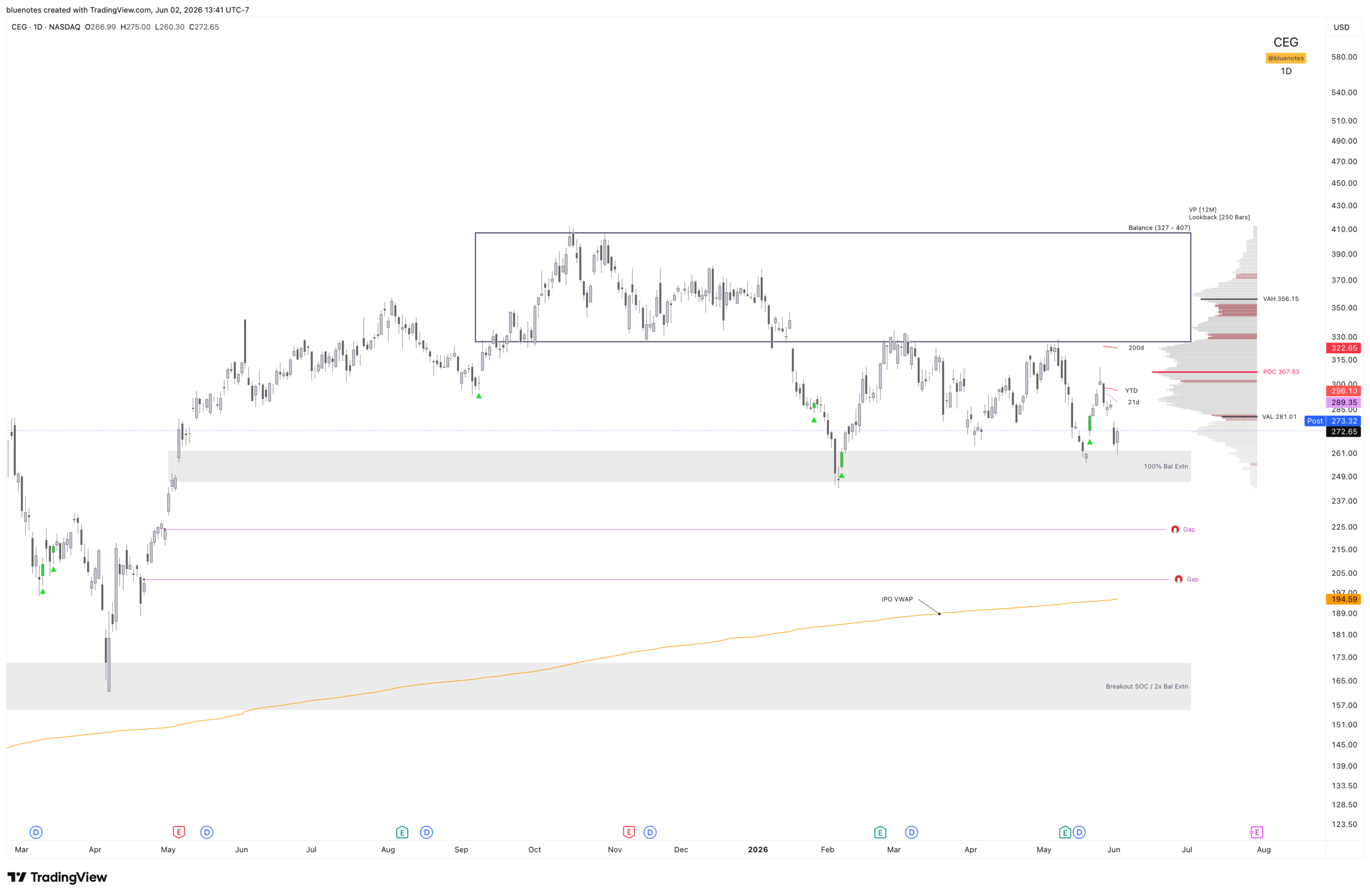
At roughly $272 per share and a market cap near $98.5B, Constellation is no longer a cheap stock on simple headline multiples. The market is already pricing in a meaningful AI-power premium. That said, the premium is not irrational if investors believe the company can convert its available clean baseload generation and gas assets into long-term premium contracts.
The stock should be valued less like a generic merchant power producer and more like a scarce infrastructure platform tied to AI, grid reliability, and clean baseload energy. The key question is not whether CEG deserves a premium; it does. The more important question is how much future contract upside is already reflected in the share price.
Bull Case
The bull case is that Constellation signs multiple large, long-term hyperscaler and data center power agreements at premium prices, while PJM and other markets continue to experience capacity tightness. In this scenario, the company’s available nuclear generation becomes increasingly valuable, gas assets command strategic premiums, and earnings growth exceeds the 20% base EPS CAGR target through 2029.
Additional upside could come from nuclear uprates, new gas or storage opportunities, faster regulatory clarity around large-load contracting, higher capacity prices, and continued buybacks. In this case, CEG could continue to trade at a premium multiple and remain a core AI-infrastructure winner.
Bear Case
The bear case is not that Constellation is a poor business. The bear case is that expectations have moved too far ahead of realized contracts.
The main risks are regulatory pushback, delays in data center interconnection frameworks, political resistance to rising power prices, and uncertainty around who pays for grid upgrades tied to large-load growth. There is also risk that AI power demand forecasts prove too aggressive if model efficiency improves, data center buildouts slow, or hyperscalers delay projects.
Commodity risk has not disappeared either. If power prices weaken materially, the nuclear PTC provides downside support, but earnings upside would be reduced. Natural gas spark spreads, weather, plant outages, integration execution, and capacity market reforms also remain important variables.
Actionable Investor Takeaway
Constellation is one of the highest-quality ways to invest in the AI power bottleneck. The company owns scarce assets, has policy-supported downside protection, benefits from tightening capacity markets, and has a credible path to multi-year earnings growth through long-term premium contracting.
For long-term investors, CEG is a buy-on-weakness candidate rather than a chase-at-any-price stock. The ideal setup would be to accumulate on pullbacks caused by regulatory headlines, AI-demand skepticism, or broader market weakness, provided the long-term contracting thesis remains intact.
The most important items to monitor over the next 6–12 months are new hyperscaler or data center PPAs, PJM large-load policy developments, capacity auction results, progress on powered-land deals, Calpine integration, nuclear fleet performance, and any changes to 2026–2029 EPS guidance.
Bottom line: Constellation has evolved into a strategic AI-era power platform. The valuation already reflects a strong story, but the asset base is real, the demand driver is structural, and the company has multiple ways to turn power scarcity into earnings growth. For investors seeking exposure to the intersection of AI infrastructure, grid reliability, and clean baseload power, CEG remains one of the most compelling names in the U.S. market.