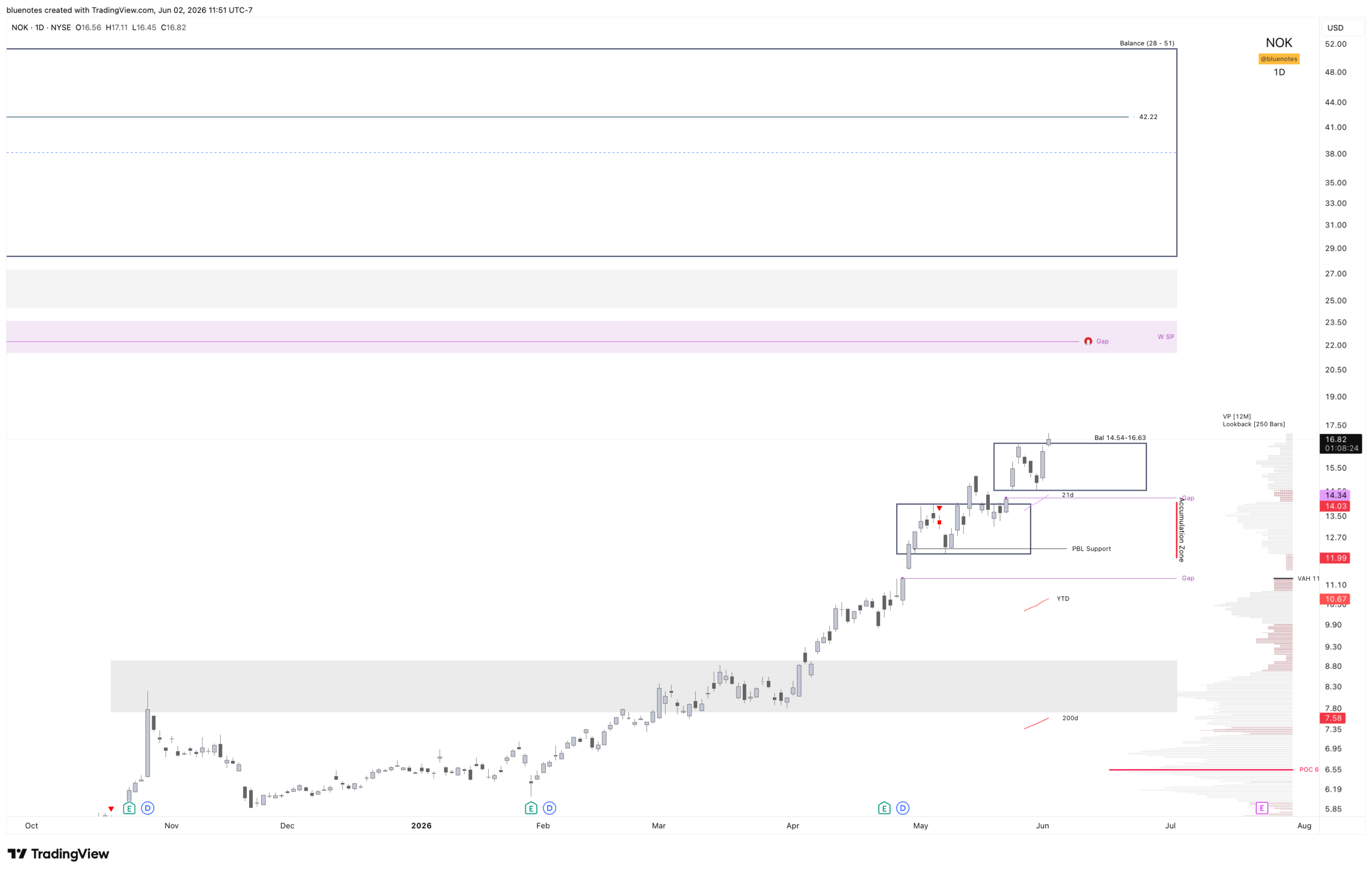
Nokia has moved from being viewed primarily as a slow-growth telecom equipment vendor to one of the more interesting “AI plumbing” plays in public markets. The company is no longer just selling radio access network hardware into telco capex cycles. Under CEO Justin Hotard, Nokia is repositioning around optical networking, IP routing, data center interconnect, AI-RAN, and AI-native 6G infrastructure.
The investment case is that Nokia may be entering a new earnings cycle driven by AI and cloud demand, while still trading with the investor baggage of a legacy telecom vendor. The risk is that the market has already started to price in this transformation aggressively, and execution now has to catch up with the story.
Nokia’s reorganization became effective January 1, 2026, creating two primary segments: Network Infrastructure, which includes Optical Networks, IP Networks, and Fixed Networks, and Mobile Infrastructure, which includes Core Software, Radio Networks, and Technology Standards. Nokia also moved several non-core businesses into a separate Portfolio Businesses segment while it evaluates their future direction.
The strategic logic is straightforward: Network Infrastructure becomes the AI and cloud growth engine, while Mobile Infrastructure becomes the platform for AI-native networks, 6G, radio software, and patent monetization. Nokia’s stated priorities are to accelerate AI and cloud growth, lead AI-native 6G connectivity, co-innovate with customers, focus capital where it can differentiate, and unlock sustainable returns.
Core Thesis
Nokia is becoming a leveraged play on the buildout of AI networking infrastructure, especially the part of the stack that connects data centers, moves bandwidth over long distances, and eventually brings AI compute closer to the edge through AI-RAN.
This is not the same type of AI exposure as NVIDIA, Arista, Broadcom, or Marvell. Nokia is more exposed to optical transport, IP networks, telecom infrastructure, data center interconnect, RAN software, and future 6G architecture. That makes it a less pure AI compute play, but potentially an important second-derivative beneficiary of AI infrastructure spending.
The strongest part of the thesis is Network Infrastructure, especially Optical Networks. In Q1 2026, Nokia reported 4% group net sales growth, 6% growth in Network Infrastructure, and 20% growth in Optical Networks. AI and Cloud net sales grew 49% and represented 8% of group sales, while Nokia booked €1 billion of AI and Cloud orders during the quarter.
That order number is important because it suggests the AI narrative is no longer just strategic messaging. It is beginning to show up in demand, backlog, and guidance. Nokia raised its 2026 Network Infrastructure growth assumption from 6%–8% to 12%–14%, with Optical Networks and IP Networks now expected to grow 18%–20%.
Business Segments
Network Infrastructure is the main reason to own the stock. This segment provides the backbone layer for AI data center growth, including optical transport, IP routing, fixed networks, and data center connectivity. AI training and inference require enormous amounts of bandwidth, and as workloads expand across regions and between data centers, optical and IP infrastructure become more important.
Nokia’s Optical Networks business is especially relevant because AI clusters are increasingly constrained by power, distance, latency, and bandwidth. Nokia launched a new suite of application-optimized optical solutions at OFC, including four new DSPs powering 13 new solutions, with the company claiming up to 70% TCO savings for customers.
The Infinera acquisition strengthens this part of the story. Nokia completed the acquisition in February 2025, creating a larger optical networking business with more exposure to data center demand. Reuters reported the deal value at $2.3 billion, and the European Commission approved it after concluding that the combined market position would remain moderate and face credible competition.
Mobile Infrastructure is the more speculative upside option. This segment includes Radio Networks, Core Software, and Technology Standards. The near-term business remains tied to telco capex, which has been a difficult market, but the long-term pitch is that mobile networks will evolve from connectivity platforms into distributed AI compute platforms.
The NVIDIA partnership is central here. Nokia and NVIDIA announced a strategic partnership in October 2025, with NVIDIA agreeing to invest $1 billion in Nokia at $6.01 per share, giving NVIDIA a 2.9% stake. The partnership is focused on AI-RAN and future 6G infrastructure.
Nokia has since reported progress with AI-RAN, including 10 publicly committed customers and plans to begin customer trials later in 2026. Publicly named partners and customers include T-Mobile, SoftBank, Indosat, BT, Elisa, NTT DOCOMO, and Vodafone Group.
This is a meaningful strategic development, but investors should be careful not to over-discount AI-RAN revenue too early. AI-RAN is promising, but broad commercial adoption likely depends on carrier economics, GPU cost, power availability, edge AI demand, and whether operators can actually monetize spare compute capacity. The bull case is that Nokia becomes a key software and systems partner for AI-native mobile networks. The bear case is that AI-RAN remains a long-dated technology story that does not materially affect earnings until closer to 2030.
Competitive Position
Nokia’s moat is strongest in optical networking, telecom standards, patents, R&D depth, and integrated network architecture. Nokia Bell Labs remains a valuable research engine, while the company’s Technology Standards business provides recurring, high-margin licensing economics.
The company’s vertical integration is also strategically important. Nokia’s ownership of optical technology, silicon expertise, and manufacturing capacity can become an advantage if AI-related demand tightens component supply. The San Jose InP fab expansion discussed in the original note is directionally consistent with Nokia’s strategy, but the specific “25x capacity by 2027” claim should be treated as a management or industry claim that needs direct source confirmation before being used as a hard underwriting input.
Against competitors, Nokia is best viewed in three layers.
- In data center interconnect and optical transport, Nokia competes with Ciena, Huawei, Cisco, and others. This is the strongest AI infrastructure angle.
- In AI data center switching, Nokia is still more of a challenger or second-source candidate. Arista and Cisco remain stronger incumbents inside the data center scale-out layer. Nokia does not need to beat Arista to win; it needs to show credible share gains as hyperscalers diversify suppliers.
- In RAN and mobile infrastructure, Nokia competes primarily with Ericsson and Huawei, with Samsung also present in selected markets. Huawei restrictions in parts of Europe and North America remain a structural tailwind for Nokia and Ericsson, though replacement cycles can be slow and politically uneven.
Financial Profile
Nokia’s Q1 2026 results showed early signs of operating leverage, but the margin story is still in progress. Q1 net sales were €4.5 billion, gross margin was 45.5%, operating margin was 6.2%, free cash flow was €0.6 billion, and net cash was €3.8 billion.
Network Infrastructure had a Q1 operating margin of 6.7%, while Nokia’s 2028 target for Network Infrastructure operating margin is 13%–17%. The gap between today’s margin and the 2028 target is one of the key investment debates. If Nokia can scale Optical and IP Networks while improving mix and absorbing Infinera integration costs, the earnings power could be meaningfully higher. If AI demand slows or telco weakness persists, the margin bridge becomes harder.
At the group level, Nokia targets comparable operating profit of €2.7 billion to €3.2 billion by 2028, up from roughly €2.0 billion in the prior baseline period. It also targets Network Infrastructure net sales CAGR of 6%–8% from 2025 to 2028, including 10%–12% for Optical Networks and IP Networks, although Q1 2026 guidance now implies stronger near-term momentum.
The current valuation already reflects a significant shift in investor perception. NOK recently traded around $16.84, with a market cap of roughly $93.0 billion. That is a very different setup from when NVIDIA invested at $6.01 per share in 2025.
Bull Case
The bull case is that Nokia becomes a recognized AI infrastructure compounder rather than a discounted telco equipment vendor. The cleanest path is through continued strength in Optical Networks and IP Networks, with AI and cloud orders converting into revenue growth, margin expansion, and higher investor confidence in the 2028 profit target.
The strongest upside catalysts are further hyperscaler wins, data center switching traction, higher adoption of 800G/1.6T/3.2T optical solutions, improved supply visibility, and evidence that AI and Cloud revenue can become a much larger share of group sales.
AI-RAN is a secondary upside catalyst. It could become very important over the long term, but it should not be the only reason to own the stock. The nearer-term earnings case still rests more heavily on Network Infrastructure.
Bear Case
The bear case is that the stock has already rerated faster than fundamentals. Nokia’s AI and Cloud revenue is growing quickly, but it still represented only 8% of group sales in Q1 2026. That is meaningful, but not yet enough to fully transform the company’s earnings mix.
Execution risk is also real. Nokia must integrate Infinera, expand optical capacity, win more hyperscale business, compete against stronger data center incumbents, and maintain discipline in a still-cyclical telecom market.
Telco capex remains a major overhang. Operators have struggled to earn attractive returns on 5G investment, which can pressure Radio Networks and delay upgrades. If mobile spending stays weak, the Mobile Infrastructure business may remain more of a cash-flow and patent story than a growth story.
Finally, AI-RAN commercialization may take longer than investors expect. There is a big difference between trials, demonstrations, and scaled revenue. Carriers will need a clear economic model before deploying GPU-accelerated RAN at scale.
What Investors Should Track
The most important metric is AI and Cloud order conversion. Nokia’s €1 billion of Q1 AI and Cloud orders is impressive, but investors need to see those orders convert into revenue, margin, and repeat demand.
Second, watch Network Infrastructure growth and margin. The company raised its 2026 growth assumption for the segment to 12%–14%, so any deceleration below that range would likely challenge the rerating.
Third, track Optical Networks growth. Q1 growth of 20% was the standout number. Sustained strength here would support the view that Nokia has become a direct beneficiary of AI data center buildout.
Fourth, monitor hyperscaler design wins. Nokia does not need to dominate AI switching, but it does need to prove that major cloud customers view it as a credible supplier beyond traditional telecom networks.
Fifth, watch AI-RAN customer trials. The next step is not more partnership announcements. The next step is evidence of commercial deployments, operator economics, and revenue contribution.
Actionable Investor View
Nokia is no longer just a legacy telecom equipment name. The company now has a credible AI infrastructure story built around optical networking, IP networks, data center interconnect, and AI-RAN. The business has real catalysts, and Q1 2026 provided tangible evidence that AI and cloud demand is flowing into orders and guidance.
The risk is valuation and timing. After the move from NVIDIA’s $6.01 investment price to the current mid-teens share price, the stock is no longer an undiscovered turnaround. Investors are now paying for a successful transformation, not merely optionality.
For long-term investors, the cleanest approach is to treat Nokia as a watchlist or pullback candidate rather than a simple chase. The best setup would be a reset toward support or a consolidation that allows fundamentals to catch up with the stock. The most attractive entries would likely come when the market questions AI infrastructure spending broadly, but Nokia continues to show strong Network Infrastructure orders, Optical growth, and margin progress.
For existing holders, the key is to stay focused on the 2028 bridge: can Nokia move from roughly €2.0 billion of comparable operating profit toward €2.7 billion–€3.2 billion while growing Network Infrastructure and improving mix? If yes, the rerating can continue. If AI and cloud demand fades, or if the margin bridge stalls, the stock could quickly revert to being valued as a cyclical telecom vendor.
Bottom Line
Nokia is becoming one of the more credible “AI infrastructure at a non-pure-play valuation” stories, but the easy part of the rerating may already be behind it. The investment case is strongest when centered on Optical Networks, IP Networks, hyperscale demand, and Network Infrastructure margin expansion. AI-RAN adds long-term upside, but it should be treated as a future option rather than the core near-term earnings driver.
The stock belongs on the radar for investors seeking exposure to the networking layer of AI infrastructure, especially those who missed the earlier move in higher-multiple AI networking names. The actionable takeaway is to watch for pullbacks, monitor AI and Cloud order conversion, and use Network Infrastructure margin progress as the primary signal for whether Nokia’s AI transformation is real or overhyped.