Oracle Investment Strategy: The AI Infrastructure Re-Rating Thesis
The investment case for Oracle is centered on one core idea: if AI demand is real, and if OpenAI remains a viable long-term customer, then Oracle Cloud Infrastructure should continue to gain strategic relevance. Under that framework, Oracle becomes a compelling investment because OCI is no longer just a secondary cloud platform. It is becoming a critical AI infrastructure provider.
The thesis comes down to two key questions:
- Can OpenAI fulfill its long-term infrastructure commitments?
- Is AI demand durable enough to support the next wave of hyperscale cloud buildout?
If the answer to both questions is yes, then Oracle’s risk/reward becomes attractive. OCI is positioned to benefit from one of the largest compute demand cycles in technology history, and Oracle’s partnership with OpenAI gives it a direct seat at the table.
If the answer is no, then investors should stay away. A bet against Oracle in this context is effectively a bet that either OpenAI fails to honor its commitments or that AI infrastructure demand proves overstated. But if either of those outcomes becomes true, the risk would not be isolated to Oracle. It would likely pressure the entire AI value chain, including semiconductors, cloud providers, data center operators, power infrastructure, and financing partners.
Oracle may be perceived as the first weak link because of the size and concentration of its OpenAI-related opportunity. I disagree with that view. The more important point is that Oracle is being repriced around the uncertainty of revenue that has not yet fully materialized. That creates opportunity if those commitments begin converting into actual revenue over the coming quarters and years.
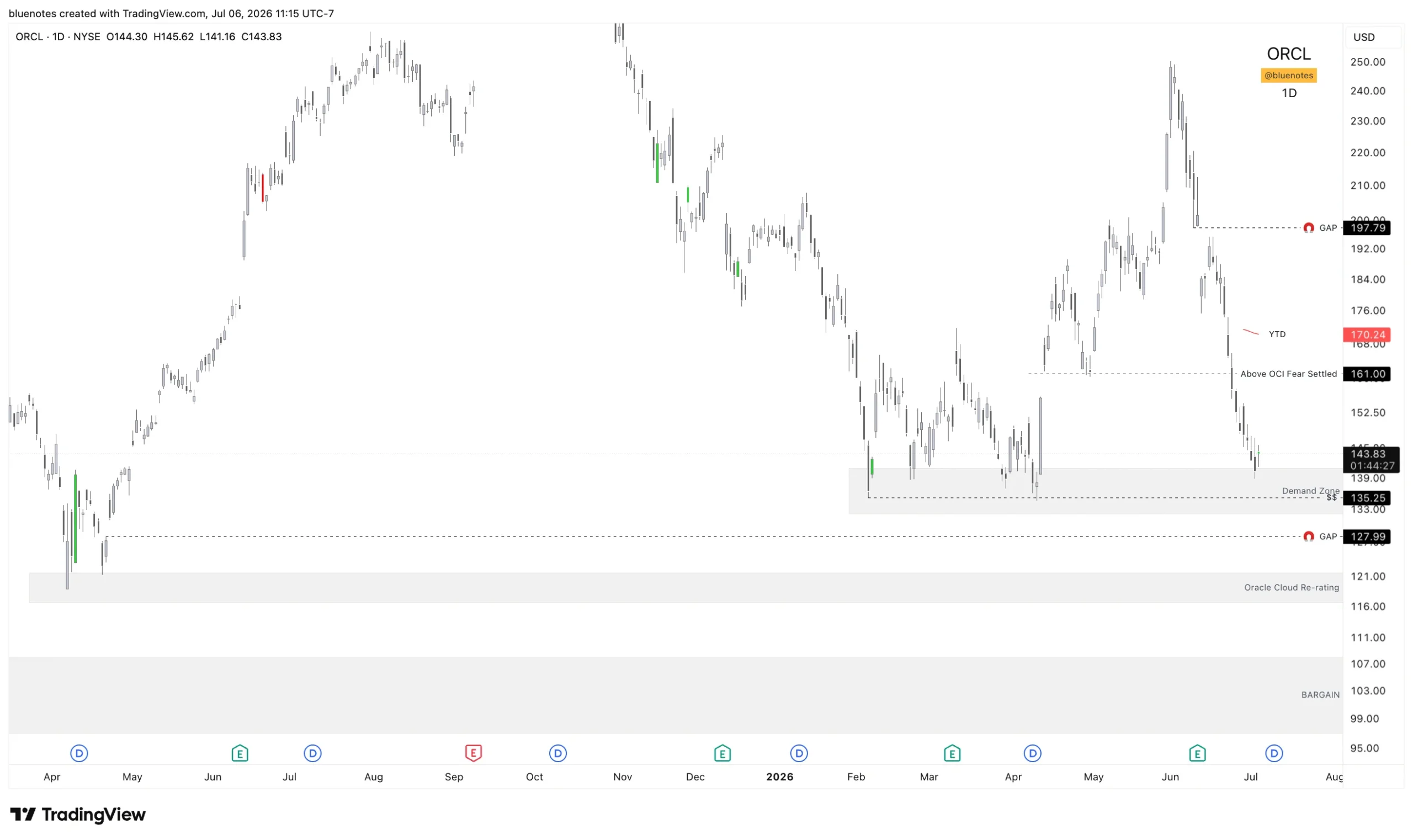
The stock has also retraced back toward levels where the market originally began pricing in Oracle’s expanded OpenAI partnership. In practical terms, much of the perceived value from that deal appears to have been wiped out. If OpenAI-related revenue starts to flow through OCI, Oracle could be positioned for a meaningful re-rating.
This setup is similar in concept to Microsoft after its OpenAI investment. Microsoft eventually traded marginally below the level where the OpenAI relationship was first announced before the market began to better understand the strategic value of that partnership. If Oracle follows a similar price-action path, a panic move toward the open gap near $128 could represent a key opportunity area. Ideally, that zone, or nearby support levels, would hold and form the base for a longer-term recovery.
Strategic Validation
Oracle’s transformation is being driven by Oracle Cloud Infrastructure. OCI has moved from being a niche cloud alternative to becoming a serious hyperscale AI infrastructure platform.
OCI revenue growth has accelerated sharply, supported by GPU demand, AI training clusters, and large-scale customer commitments. Management has also secured significant data center capacity to support future demand, reinforcing the idea that Oracle is no longer playing small in cloud infrastructure.
The reported multi-year OpenAI cloud agreement is the centerpiece of the thesis. If realized, it could represent one of the most important infrastructure contracts in Oracle’s history and would account for a major portion of Oracle’s remaining performance obligations. That level of backlog gives investors visibility, but it also explains why the market is focused so heavily on execution risk.
Oracle is also tied into the broader Stargate AI infrastructure ecosystem alongside major technology and capital partners. Its Abilene, Texas campus is expected to serve as a flagship AI compute facility, supported by next-generation NVIDIA systems and massive power requirements. This further validates Oracle’s strategic pivot from traditional enterprise software and databases into mission-critical AI infrastructure.
Bear Case Rebuttal
The bear case is straightforward: Oracle is taking on enormous financial and execution risk to serve a highly concentrated customer base, with OpenAI being the most important counterparty. If OpenAI cannot meet its commitments, or if AI demand slows meaningfully, Oracle could be left with expensive infrastructure and lower-than-expected returns.
That risk is real, but it may be overstated.
First, OpenAI is not an isolated startup operating without support. It is backed by some of the deepest pools of capital and strategic interest in the technology sector. The incentive structure around OpenAI is clear: too many major players have too much at stake to let the company fail easily.
Second, AI compute demand remains supply constrained. Management commentary across the industry continues to suggest that high-end AI infrastructure is effectively sold out in the near term. Demand is not limited to OpenAI. It also includes enterprises, sovereign governments, model developers, and other AI-native businesses competing for access to compute.
Third, Oracle is using financing structures that may reduce some of the burden of the buildout. Customer prepayments and bring-your-own-hardware arrangements can shift portions of the capital and component risk away from Oracle, helping to de-risk the infrastructure expansion.
Investment Conclusion
Oracle is not a low-risk investment. It is a high-conviction AI infrastructure trade with a clear binary element: investors must believe in both OpenAI’s ability to fulfill its commitments and the durability of AI infrastructure demand.
If those assumptions hold, Oracle is positioned for a potential re-rating as OCI revenue converts from promise to reported results. The market has already punished the stock by retracing much of the OpenAI-related premium. That creates an opportunity for investors who believe the market is underestimating Oracle’s role in the AI infrastructure buildout.
The strategy is simple: own Oracle only if you believe AI demand is real and OpenAI remains financially and strategically supported. If either assumption breaks, avoid the stock. But if both assumptions remain intact, Oracle’s current weakness may represent a compelling long-term entry point into one of the most important AI infrastructure stories in the market.