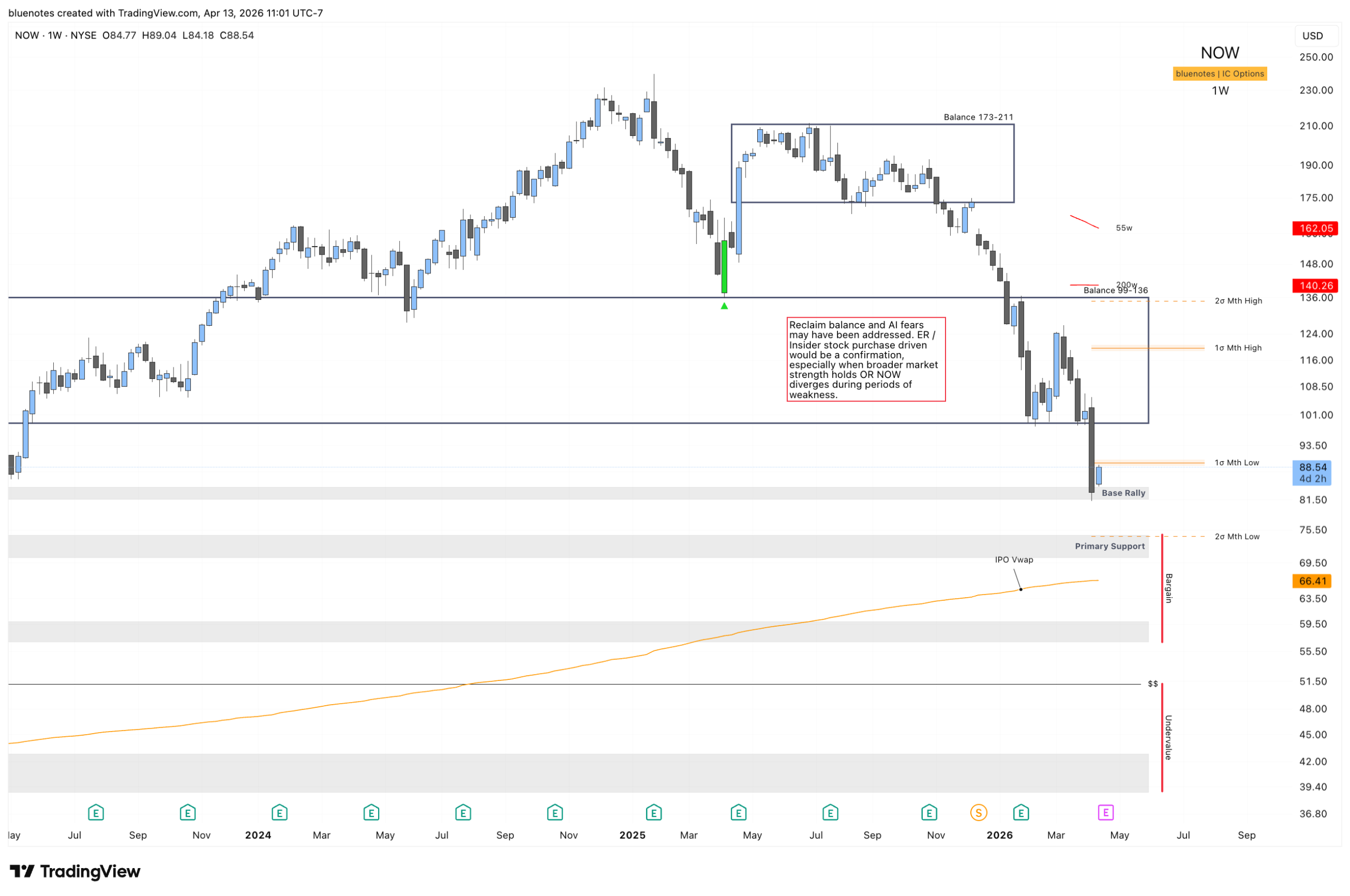
Long term position
Additional entries: Below $70-75, 56-60,
ServiceNow is a top pick in the SaaS sector because it serves as the “AI Control Tower” for the modern enterprise, leveraging a unified “one platform, one architecture, one data model” approach to orchestrate complex, cross-departmental workflows that fragmented legacy tools cannot easily replicate. Its economic moat is reinforced by high switching costs, a foundational “data moat” within its Configuration Management Database (CMDB), and a massive ecosystem of over 2,700 global partners that create significant barriers to entry for new competitors.
Financially, the company maintains a rare “Rule of 55+” profile, with 2026 revenue projected to approach $16 billion and free cash flow margins exceeding 35%, driven by a successful “land and expand” strategy that frequently bundles seven or more products in large enterprise deals. Unlike many peers vulnerable to AI disruption, ServiceNow is positioned as a primary beneficiary of the agentic AI cycle, providing the critical governance, security, and execution layer required to manage millions of AI agents across diverse IT environments.
ServiceNow has moved beyond “sidecar” AI to an AI-native experience across its entire portfolio. Its AI Control Tower serves as a governance backbone, allowing enterprises to manage, monitor, and secure millions of AI agents, whether they were built on ServiceNow or by third parties like Microsoft or OpenAI.
Strategic Partnerships and Acquisitions
Model Neutrality: ServiceNow maintains a “Switzerland” strategy, integrating with NVIDIA, OpenAI, Anthropic, and Microsoft to give customers flexibility in which LLMs they use to power their workflows.
Agentic AI Focus: The 2025 acquisition of Moveworks strengthens its “front door” conversational AI, while acquisitions like Veza and Armis (expected to close in 1H 2026) extend its reach into AI security and asset management.
Comparison to Peers
Vs. Microsoft: While Microsoft dominates general productivity (Copilot in Office 365), ServiceNow excels at complex, cross-functional business processes that require multi-step orchestration.
Vs. Salesforce: ServiceNow is increasingly competing head-on with Salesforce in the CRM space, but is viewed by some partners as having a more unified platform narrative for the AI agent race.
Vs. Atlassian: ServiceNow is often the preferred choice for large-scale enterprise governance and “Service Management,” whereas Atlassian’s Jira is favored for developer-led, agile environments.
Chart: