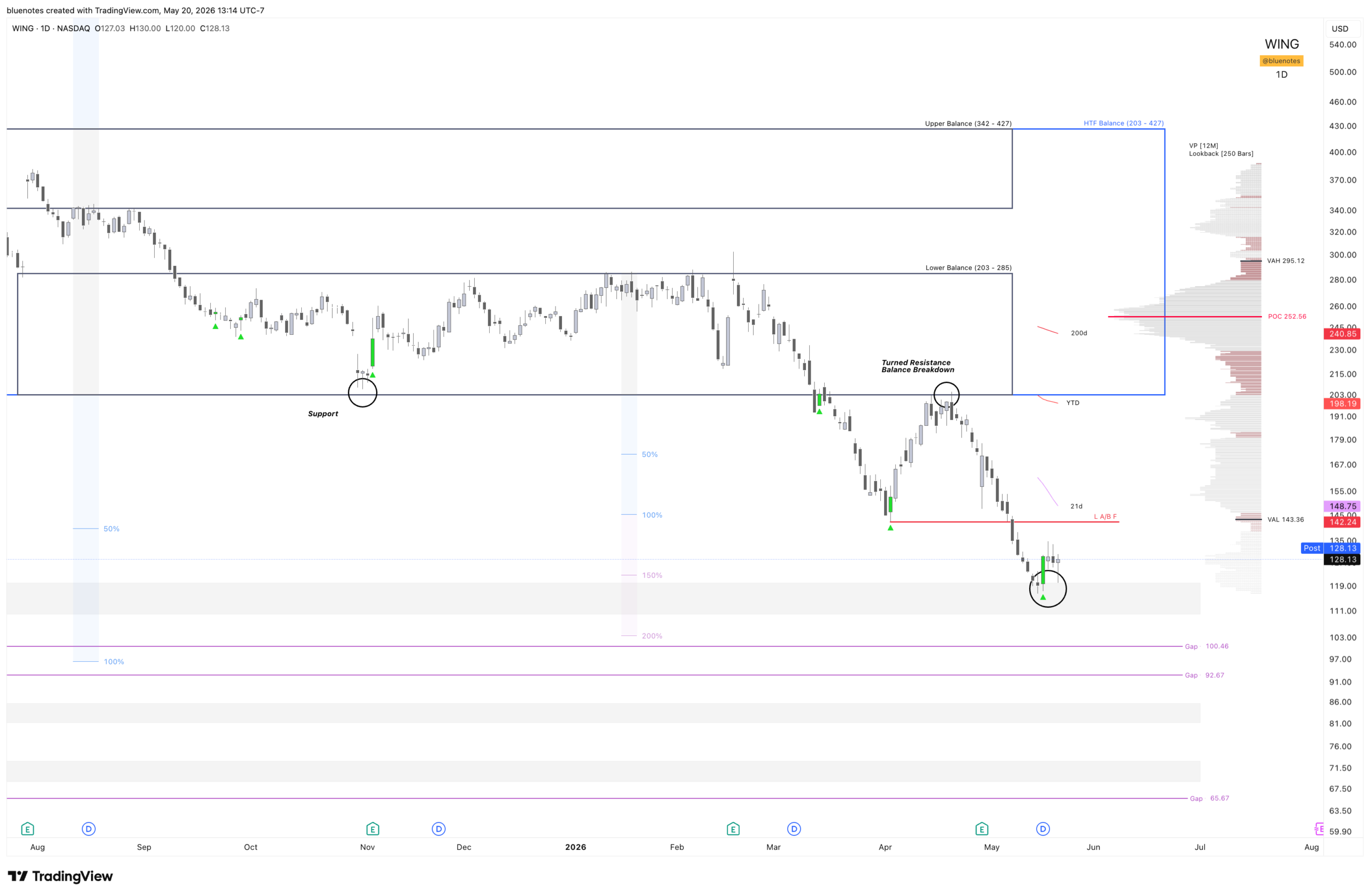
Wingstop is a high-quality, asset-light growth story currently going through a real consumer-demand reset. The long-term thesis is still attractive, but the stock has become a battleground because premium unit growth and strong margins are being offset by weak same-store sales, lower transaction volumes, and rising competition in chicken.
As of Q1 2026, Wingstop had 3,153 global restaurants, with 3,096 franchised and 57 company-owned, meaning the business remains roughly 98% franchised. That is the core of the model: low capital intensity, high royalty flow-through, strong free cash flow characteristics, and less direct exposure to store-level labor and food-cost volatility than company-operated restaurant chains.
The biggest current red flag is demand. Domestic same-store sales declined -5.8% in Q4 2025 and worsened to -8.7% in Q1 2026. Management attributed the weakness primarily to lower transaction volumes and pressure on the consumer. This matters because Wingstop had been priced like a durable high-growth compounder, and negative comps force investors to question whether the issue is temporary macro pressure or a more structural maturation/competition problem.
The margin profile remains the strongest part of the story. In Q1 2026, revenue was about $183.7 million, adjusted EBITDA was about $65.4 million, and adjusted EBITDA margin was approximately 35.6%. That margin performance held up despite the same-store sales miss, which supports the view that the franchise model has real profit durability. Lower bone-in wing costs also helped company-owned restaurant cost of sales improve to 74.9% of company-owned sales, versus 76.0% a year earlier.
Digital remains a major moat, but the exact figure should be cleaned up. The report says “over 75%” of sales are digital; the more recent reported numbers were 73.2% in Q4 2025 and 72.5% in Q1 2026. Still, a digital mix above 70% is exceptional for restaurants and gives Wingstop strong advantages in first-party customer data, targeted promotions, delivery/takeout behavior, and loyalty-program leverage.
Unit growth remains impressive. Wingstop ended 2025 with 3,056 restaurants, opened 493 net new restaurants in 2025, and reached 3,153 restaurants by Q1 2026. Management continues to target 10,000+ global restaurants, including roughly 6,000+ U.S. units and 4,000+ international units. That runway is the main reason the stock continues to deserve investor attention even during a comp downturn.
The AUV and franchise economics remain central to the bull case. Wingstop’s domestic AUV is around $2 million, with a long-term target of $3 million. The report’s claim of roughly $580,000 upfront investment, 70%+ unlevered cash-on-cash returns, and a less-than-two-year payback period is directionally consistent with why franchisees keep developing units. If those economics hold even with softer comps, the development story remains intact.
The competitive threat from Popeyes should be taken seriously but not overstated. Popeyes has made wings a more permanent part of its platform and is using its much larger footprint, marketing scale, and value orientation to compete for chicken occasions. However, there is not enough evidence yet to say Popeyes is definitively taking share from Wingstop. The better framing is that the entire chicken category has become more competitive at the same time lower-income consumers are under pressure.
Wingstop’s response is focused on value, flavor, and speed. The company has used value-oriented bundles such as the $24.99 Flavor Lineup, lower-priced combos such as $9.99 tender combos and $8.99 chicken sandwich combos, and flavor LTOs like Citrus Mojo, launched April 7, 2026. These efforts are meant to defend frequency without abandoning the brand’s flavor-led positioning.
Smart Kitchen and loyalty are important upside levers. The report’s claim that Smart Kitchen has improved ticket times and delivery satisfaction appears directionally credible. The key investment question is whether these tools can translate into better throughput, higher order accuracy, better delivery satisfaction, and eventually better traffic. The national rollout of Club Wingstop loyalty in 2026 could also help restore frequency and improve customer targeting.
The biggest financial caution is balance sheet leverage. Wingstop had roughly $1.21 billion of long-term debt at Q1 2026. The model can support debt because royalty revenue is high-margin and recurring, but leverage raises the stakes if comps remain negative longer than expected. Also worth noting: the company repurchased shares in Q1 2026 at an average price of about $208.08, well above the current stock price near $128, which is not ideal from a capital allocation optics standpoint.
My investment summary: WING is a high-quality compounder, but not a low-risk entry yet. The business still has a strong moat through its asset-light model, digital mix, simple operations, high franchisee returns, flavor differentiation, and long unit runway. However, the stock needs evidence that same-store sales are bottoming before it deserves a renewed premium multiple.
The bull case is that the current weakness is a temporary consumer air pocket. If comps stabilize, unit growth stays in the mid-teens, digital remains above 70%, Smart Kitchen improves service times, and loyalty lifts frequency, Wingstop can continue compounding earnings at an attractive rate.
The bear case is that Wingstop’s lower-income consumer exposure, chicken-category competition, and potential market saturation in core states make the brand more cyclical than previously believed. If negative comps persist while competition forces heavier value promotions, the market may continue compressing the multiple.
For positioning, I would treat WING as a quality name to build tactically, not a chase. A small starter can make sense for long-term investors, but the better confirmation comes from improving transaction trends, domestic same-store sales moving toward flat, sustained 15%+ unit growth, and adjusted EBITDA margins holding in the mid-30% range.